SYSTEMS
Our engineered fire suppression and detection systems are trusted by organisations across the UK, Ireland and Europe to protect complex and mission-critical facilities.
Sprinkler systems play a key role in life safety – there has been no loss of life in a fire where sprinklers were installed, and 96% of fires were controlled by sprinklers alone.
But early detection is just as vital: in high-density environments, the earliest signs of fire are often invisible small particulate changes. Detecting them early allows time to investigate and intervene before suppression is ever needed, avoiding unnecessary discharge and disruption.
Effective fire protection systems are essential for controlling fires quickly and minimising damage. When designed correctly, systems such as sprinklers can suppress or control fires in their early stages, protecting both life safety and business continuity.
At Alpine Fire, we take a fully engineered approach to fire protection. We deliver complete fire suppression and detection systems, from initial concept and system design through to installation, commissioning and long-term maintenance.
Our work does not end once a system is installed. Alpine Fire provides ongoing inspection, servicing and maintenance to ensure your fire suppression and detection system remains compliant, reliable and ready to perform, if needed.
With decades of experience delivering fire protection systems across the UK, Ireland and Europe, Alpine Fire helps organisations protect their people, assets and operations with confidence.
Protecting People, Property and the Planet.
Fire sprinkler systems detect heat from a fire. When temperatures rise, the nearest sprinkler head activates and releases water directly onto the fire, helping to control or extinguish it quickly.
These systems are widely used across commercial buildings, residential properties, warehouses, and industrial sites in the UK.
No in general terms this is a misconception. Under a standard wet or dry fire sprinkler systems individual heat-activated sprinkler heads are designed to operate as the heat rises from a fire directly below the head. On average one or two heads is enough to control or extinguish a typical fire.
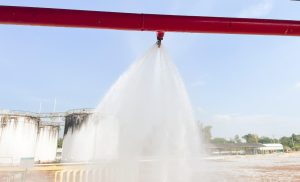
Yes. This can occur with a deluge sprinkler system, which uses open sprinkler heads or nozzles. Deluge systems are typically installed in high-risk environments.
When the system is activated, the pipework fills with water and discharges simultaneously through all open heads, providing rapid coverage across the entire protected area.
Accidental activation is extremely rare. Sprinkler heads are heat-activated, not triggered by smoke, reducing the risk of false activations.
In many cases, yes. However, sprinkler systems are designed to control and contain fires, preventing spread and allowing safe evacuation and time for fire services to attend.
While water is released during activation, fire sprinkler systems significantly reduce overall damage compared to uncontrolled fires or hoses used by Fire & Rescue services.
Early suppression helps protect property, people, and planet.
No. In the event of a fire, a properly maintained sprinkler system will typically use significantly less water than would be required if the fire were to develop unchecked and be tackled solely by the Fire & Rescue Service.
Sprinklers control or suppress a fire at a very early stage, greatly reducing overall water usage and damage.
Both are essential components of a complete fire protection system.
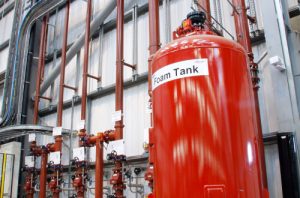
In most cases, existing foam systems cannot be directly replaced on a like-for-like basis with environmentally friendly foam. The suitability of an alternative foam depends on the specific fire risk, system design, and performance requirements.
Switching to fluorine-free or environmentally friendly foam may involve anything from a simple change of foam equipment to more extensive modifications, including pipework, discharge devices, pumps, or water storage. This is because environmentally friendly foams can currently be less effective than traditional fluorine-based foams and may require higher discharge rates to achieve equivalent fire suppression performance.
Advancements in foam technology are ongoing. Engaging a fire suppression specialist early will help determine the most compliant, effective, and environmentally responsible solution for your site.
We provide a full range of fire suppression systems in the UK, including:
Choosing the right systems depends on your building type and fire risk.
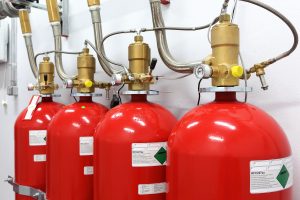
Yes. We deliver new gas suppression system installations and provide ongoing service and maintenance for all types of gas suppression systems.
Yes. Our engineers are qualified to design, install, and maintain both low‑pressure and high‑pressure water mist systems.
No. We currently focus on commercial and industrial fire suppression systems and do not offer solutions for domestic or residential properties.
Yes. Alpine provide 24/7 emergency response alongside planned preventative maintenance.